2025/08/22 - 2025/10/01, Solo Exhibition, Alternative Space LOOP, Seoul, South Korea
캐스퍼 Casper
2025
Leaflet

Ghost Without a Grave, single channel video, 5min 32sec, 2025/ Fragments of Memory, single channel video, 33min 54sec, 2025
“그들은 이름 없이 지나갔다”
《캐스퍼 Casper》는 황해도 신천에서 출생한 작가의 외할아버지에 관한 이야기에서 출발한다. 그는 광복 이후 한국에서 서북청년회로 활동했고, 미군기지에서 흘러나온 물건을 받아 판매하는 방식으로 생계를 이어갔다. 그의 이야기는 가족 내에서 금기시되었고, 사진조차 남아 있지 않다. 작가는 흔적이 사라진 외할아버지를 유령에 비유해, 가족 구술사와 아카이브의 형태로 예술 작업을 만들었다. 전시는 외할아버지의 이야기를 중심으로 역사도, 이름도 없이 사라진 이들의 서사를 예술적 상상으로 복원한다.
지주였던 외할아버지의 집안은 일제강점기와 해방, 한국전쟁을 거치며 몰락했다고 전해진다. 남쪽으로 피난한 그에게 삶의 목적은 살아남는 것이었다. 그는 북한에서 함께 내려온 가족과 남한에서 새로 꾸린 가정을 오가며 두 가족의 생계를 책임졌다. 그는 한국전쟁과 이념이라는 거대한 역사 속의 피해자이자 가해자였다. 단지 가장으로서 ‘역사도, 무게도, 이름도 없이 살아남아 말 없는 거래를 이어갔다.’ 사라지는 것은 두려운 일이었다.
전시 《캐스퍼》는 한국전쟁과 민주화운동 등 한국 근현대사를 다룬 《코리안 고스트 Korean Ghost, 2022》와 《키신 Kishin: The Generation of Postmemory, 2023》에 이은 포스트메모리 시리즈의 세 번째 프로젝트다. 전시의 제목은 영화 Casper, the Friendly Ghost에서 차용했다. 미련이나 원한을 품고 세상을 떠도는 일반적인 유령과 달리, 캐스퍼는 왜 죽었는지, 어떤 삶을 살았는지, 자신의 이름조차 모른 채 윕스태프 저택을 떠돈다. 사람들과 가까워지기를 바라는 이 따뜻한 꼬마 유령의 이미지를 빌려, 작가는 외할아버지를 비롯해 익명으로 남겨진 이들과 그들이 살아낸 시대를 위로한다. 사라진 이들은 캐스퍼가 되고, 전시장은 캐스퍼의 성이 된다.

Installation view of Lijung’s solo exhibition, Alternative Space LOOP, 2025, Photo: Soonyoung Jung
1층의 영상 〈무덤 없는 유령, 2025〉은 전시 전체를 관통하는 상징으로 작동한다. 묘비 없이 사라진 이들을 추모하기 위한 디지털 묘지로, 이름 없는 자들의 생을 기리는 작가의 시와 사운드(제작: 노은실)가 흐른다. 전시장은 아무것도 갖지 못한 이들의 쉼터가 되어, ‘그들의 숨겨진 이야기가 마침내 여기서 숨을 쉬기를 May their untold stories find breath here, at last.’ 바라는 출발점이 된다. 전시장의 벽면을 둘러싼 《언씬 내러티브즈 Unseen Narratives, 2025》는 캐스퍼를 둘러싼 역사적 풍경의 시각적 요소를 차용해 시바툴과 레진으로 재구성한 이미지 아카이브 연구이다. 중첩된 풍경 사이로 희미하게 사진 이미지가 새어 나오는데, 이는 캐스퍼가 살았을 법한 장소와 만났을 법한 인물들의 모습을 수집한 사진 조각이다. 기록되지 않은 이들의 기억은 마치 영적 에너지가 물질적 매질을 통해 구체화되는 엑토플라즘의 형태로 드러난다.
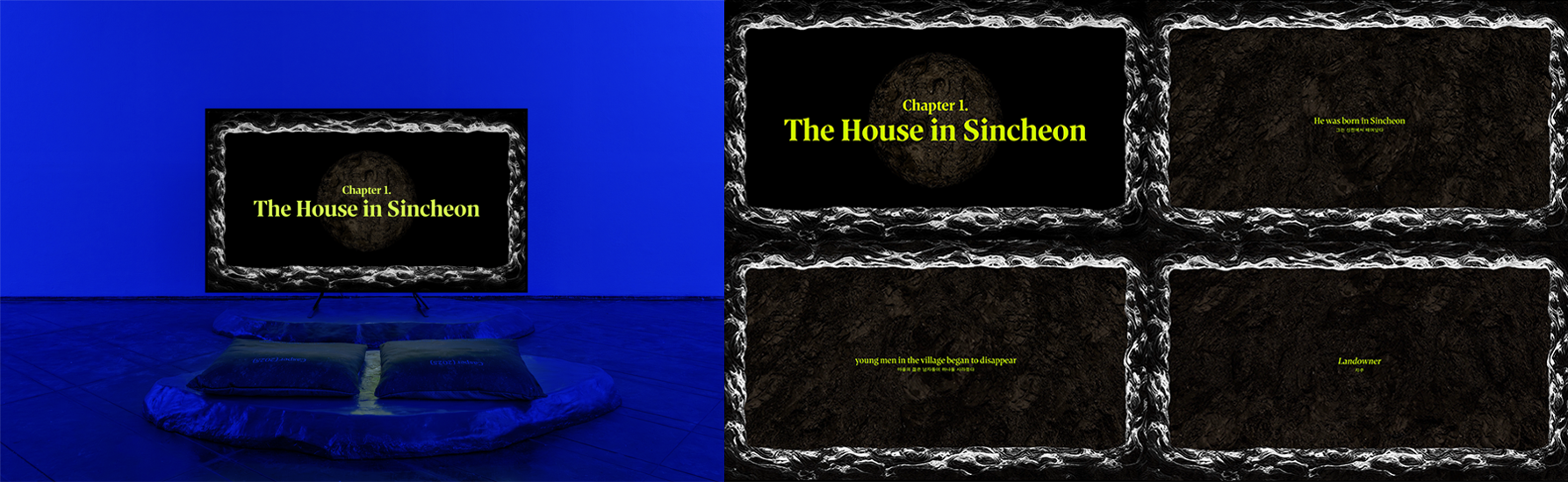
Casper: Chapter 1. The House in Sincheon, single channel video, 8min 37sec, 2025
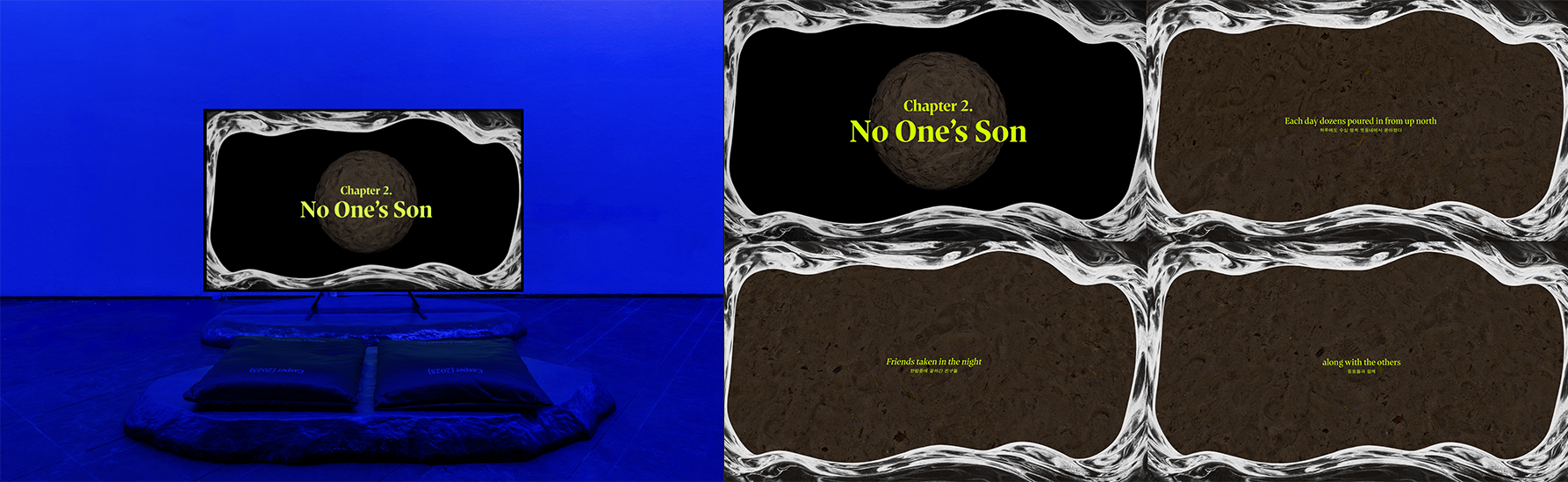
Casper: Chapter 2. No One’s Son, single channel video, 8min 11sec, 2025
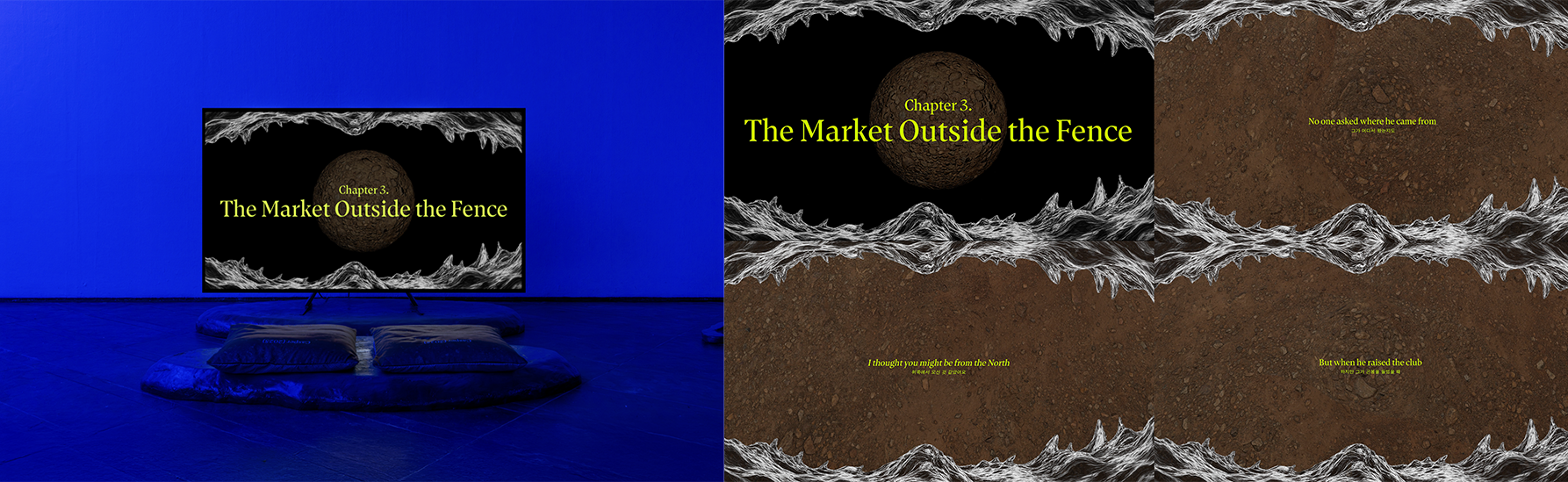
Casper: Casper: Chapter 3. The Market Outside the Fence, single channel video, 9min 3sec, 2025
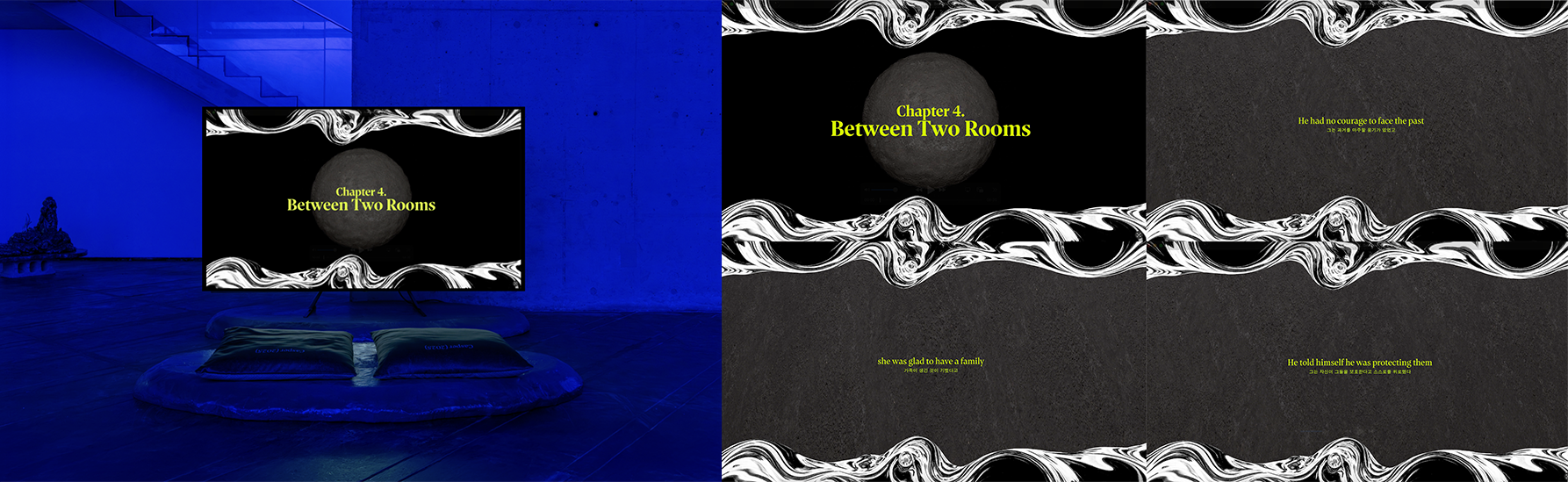
Casper: Chapter 4. Between Two Rooms, single channel video, 8min 3 sec, 2025
지하에 위치한 전시의 메인 작업 《캐스퍼, 2025》 시리즈는 땅에 가까운, 낮고 비가시적인 층위에서 살아간 인물들의 이야기로 구성되어 있으며, 관람객이 몸을 낮추어야 마주할 수 있도록 설치되었다. 이는 기록되지 않은 역사의 단면을 물리적으로 가까이 마주하게 하는 장치다. 총 네 개의 챕터로 구성된 영상은 외할아버지를 배경으로 작가가 직접 작성한 캐스퍼의 이야기로, 전쟁과 분단, 역사적 단절, 계급의 몰락, 상실, 이념과 폭력, 생존의 윤리, 감정의 부재를 따라 흐른다. 작가는 사진 한 장 없이 남겨진 이 삶을 캐스퍼에 비유해, 사라졌으나 완전히 소멸하지 않은 과거의 흔적을 소환한다.
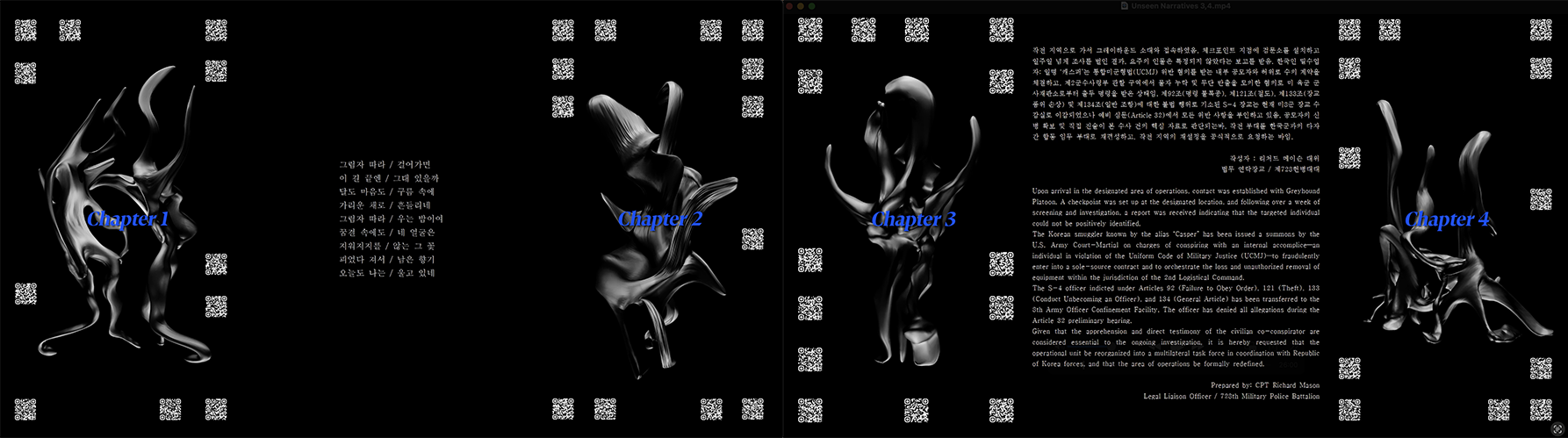
Unseen Narratives 1,2, single channel video, 24min, 2025/ Unseen Narratives 3,4, single channel video, 26min, 2025
신종원 소설가와 협업한 〈언씬 내러티브즈, 2025〉 시리즈는 반복되는 역사 속에서 흡수되어 사라지는 익명의 서사를 은유적으로 담는다. 소설은 천장에 매달린 공공장소의 전광판 형태로 제시된다. 캐스퍼가 바닥에, 익명의 존재가 천장에 위치한다면, 관람객의 눈높이에는 외할아버지에 관한 이야기를 들려주는 작가의 어머니 인터뷰 영상 〈기억의 조각, 2025〉이 재생된다. 작가는 캐스퍼에 비유된 사라진 익명을 영웅도, 악인도 아닌 ‘살아남은 자’로 바라본다. 기록의 잔재를 복원해 역사를 온전히 재현하기보다, 관람객 스스로 그 공백을 응시하고 흔적을 어루만지기를 기대한다.
글: 이선미, 대안공간 루프 큐레이터

Unseen Narratives, mixed materials, variable installation, 2025, Photo: Soonyoung Jung
“They passed without a name.”
Casper begins with the story of the artist’s maternal grandfather, who was born in Hwanghae Province in present-day North Korea. After Korea’s liberation from Japanese colonial rule, he joined the Northwest Youth Association, a far-right anti-communist paramilitary group in South Korea, and made a living by reselling goods that circulated out of U.S. military bases. Within the family, his life was shrouded in silence, with not a single photograph left behind. In Casper, Lijung likens her grandfather—whose traces have long since vanished—to a ghost. Anchored in his story, she reanimates the erased narratives of those effaced from history without names, drawing on family oral histories and archival forms.

Unseen Narratives, mixed materials, variable installation, 2025, Photo: Soonyoung Jung
Born the son of a landowner in Sinchon, the grandfather lived through Japanese occupation, liberation, and the Korean War, only to see his life collapse. After fleeing to the South, survival became his sole purpose. He moved back and forth between the family that escaped with him from the North and the new household he established in the South, providing for both. He was at once a victim and a perpetrator of the Korean War and its ideologies. As a patriarch, he “survived without history, without weight, without a name, carrying on wordless transactions.” Disappearance was a fearful fate.

Unseen Narratives, mixed materials, variable installation, 2025, Photo: Soonyoung Jung
Casper is the third project in Lijung’s postmemory series, following Korean Ghost(2022) and Kishin: The Generation of Postmemory(2023), both of which address modern Korean history, from the Korean War to the democratization movement. The title Casper is borrowed from the film Casper, the Friendly Ghost. Unlike the typical ghost bound to the world by resentment or regret, Casper wanders Whipstaff Manor without knowing his name, how he died, or what kind of life he lived. Through the warm image of this friendly ghost—one who longs to connect with people—the exhibition offers consolation to the anonymous figures of history, including the artist’s grandfather, and to the times they lived through. The vanished become Caspers; the exhibition space becomes their manor.

Unseen Narratives, mixed materials, variable installation, 2025, Photo: Soonyoung Jung
On the first floor, the single-channel video Ghost Without a Grave(2025) functions as a symbolic axis of the exhibition. Conceived as a digital cemetery commemorating those laid to rest without gravestones, it presents the artist’s poetry honoring the nameless, accompanied by sound composed by Eunsil Noh. Here, the gallery becomes a shelter for those who had nothing, a starting point for the wish that “may their untold stories find breath here, at last.”
Encircling the gallery walls, Unseen Narratives(2025) is an image-archive research project that reimagines the historical backdrops and landscapes surrounding Casper using Shibatuul and resin. Faint photographic images seep through layered reconstructions of scenery—fragments of places Casper might have lived and people he might have met. The memories of the undocumented manifest as ectoplasm: spiritual energy rendered tangible through material form.

Unseen Narratives, mixed materials, variable installation, 2025, Photo: Soonyoung Jung
The main work, Casper(2025), a four-channel video series installed in the basement, tells the stories of those who lived close to the ground, in low and invisible strata. Installed so that visitors must lower their bodies to encounter it, the work functions as a physical device that brings viewers face-to-face with unrecorded histories. Divided into four chapters, the videos recount a fictionalized narrative written by the artist against the backdrop of her grandfather’s life. Moving through themes of war and division, historical rupture, class collapse, loss, ideology and violence, survival ethics, disconnection, and emotional absence, the work summons traces of a past that has disappeared yet has not entirely dissolved.
In collaboration with novelist Jongwon Shin, the single-channel video series Unseen Narratives(2025) metaphorically captures anonymous lives absorbed and erased within the repetitive cycles of history. The text appears on an electronic message display suspended from the ceiling, recalling those found in public spaces. If Casper resides on the floor and anonymity hangs above, at the viewer’s eye level is Fragments of Memory(2025), a video interview in which the artist’s mother recounts her father’s story. Lijung regards those who have disappeared—likened to Casper—not as heroes or villains, but simply as “survivors.” Rather than restoring historical memory from archival remnants, she invites viewers to confront the void, to linger within it, and to gently touch the traces that remain.
Written by Sunmi Lee, Curator, Alternative Space LOOP
